Emergency Storm Damage in Darwin
Tree through the fence, a limb on the roof, or the driveway blocked at two in the morning. We answer the phone 24 hours for emergency storm damage in Darwin, and we can be moving while you are still on the call.
Fallen timber cleared, the site made safe, and full job documentation for your insurance claim.
- Phone answered 24/7
- $20M public liability
- Insurance documentation
- Wet season ready
If a tree is on a house, a car or a power line, ring us rather than filling in a form.
What to do right now
If a tree has come down on your place, these are the six things worth doing while you wait for us.
Treat every wire as live
If timber is touching a power line, stay well back and call the network before you call us. Do not move anything near it.
Get people and pets clear
Move everyone away from the tree and from anything it is leaning on. Hung up limbs drop without warning.
Do not climb on it
Storm damaged timber is under tension. A trunk resting on a fence can spring the moment it is cut or shifted.
Photograph everything
Take photos before anything is moved, from a few angles. Your insurer will want them, and so will we.
Leave the chainsaw in the shed
Most serious storm injuries happen during the clean up, not during the storm itself.
Call us
Tell us what has fallen and what it has landed on. We will tell you straight away whether it needs a crew tonight or in the morning.
What we do when we get there
Always included
- Hazard assessment before anyone touches the tree
- Tensioned and hung up limbs released safely
- Timber cut back off roofs, fences and vehicles
- Access to the house and driveway reopened
- Site made safe before we leave, even if the full job waits
- Photos and written job documentation for your claim
- Storm waste cleanup and green waste hauled away
- Site raked clean once the work is finished
Priced separately
- Full removal of what is left standing
- Stump grinding once the trunk is out
- Repairing fences, gutters or structures
- Clearing an entire block after a big blow
We make the site safe first and quote the rest afterwards. Nobody is asked to approve a full scope of works while a tree is sitting on their roof.
What we clear after a blow
Every wet season brings the same jobs.
These are the calls we get most between November and April.
Storm waste cleanup
Scattered green waste, snapped limbs and heavy foliage across the yard. We clear the debris, open the driveway back up and make the block usable again.
Fallen tree removal
Whole trees down across yards, fences, driveways and roads. Fallen timber gets cut up, lifted out and taken away.
Uprooted trees
Saturated ground lets root plates lift. An uprooted tree still standing is the most dangerous thing on the block and needs dropping properly.
Trees on roofs and structures
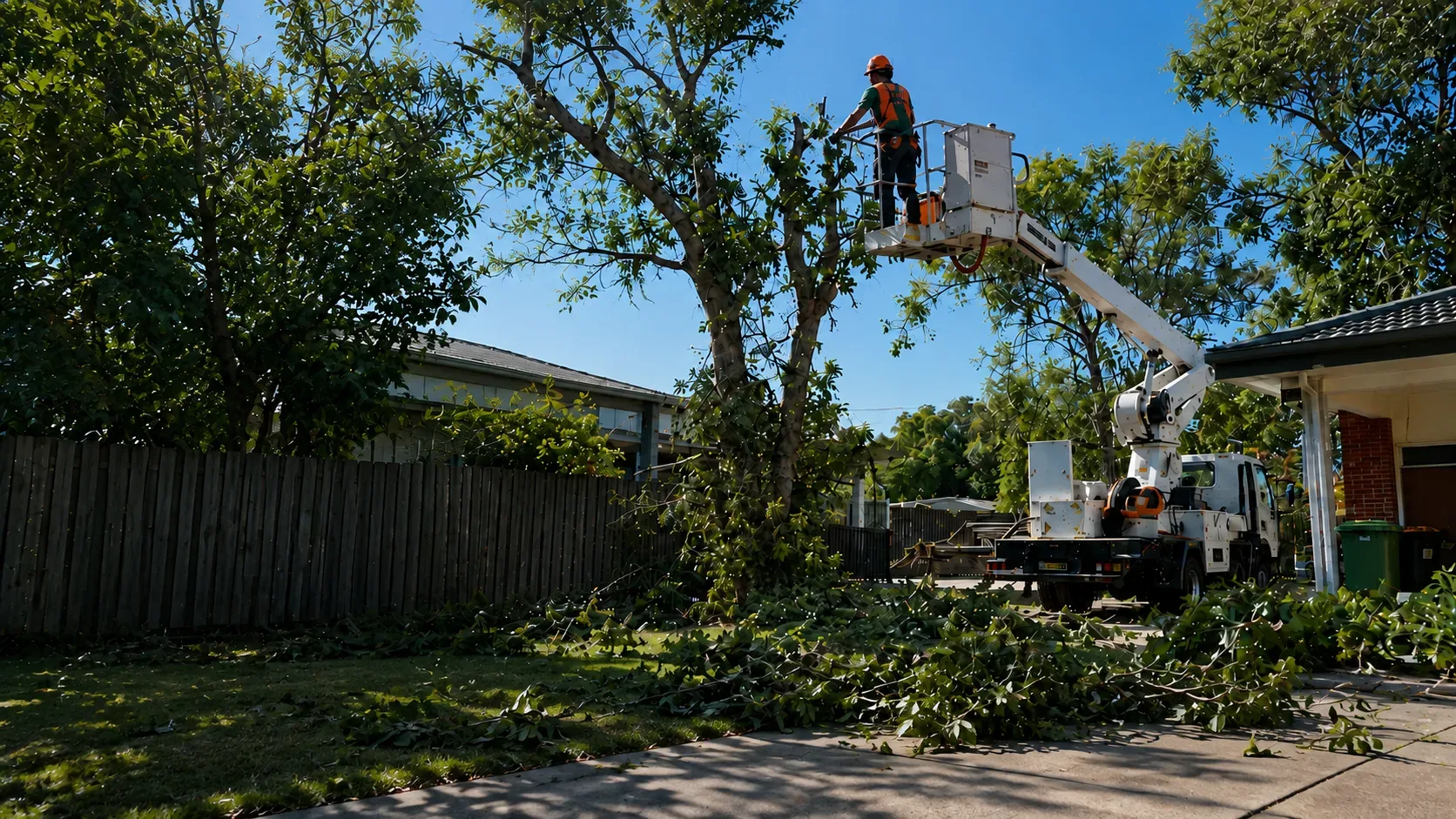
Timber resting on a house, carport, shed or fence. Everything is roped and lifted off rather than dragged, so the damage does not get worse.
Hung up and split limbs
Half broken limbs caught in the canopy are under load and drop without warning. These come down first, before anything else is touched.
Blocked access
Driveways, gates and rural tracks cut open so you can get a car out and trades can get in.
What changes the price of a storm callout
Emergency work is quoted differently to booked work, because we are coming out at short notice with whatever the job needs.
Five things move the number.
-
How urgent it is A tree blocking a driveway tonight costs more than the same tree cleared on Thursday. We will tell you honestly which one it is.
-
What it landed on Timber on open ground is straightforward. Timber on a roof or a fence has to come off in controlled sections.
-
Size and species A snapped poinciana limb is a different job to a mature mahogany across the yard.
-
Access Wet ground, a blocked drive or a back yard with no gate all change what we can get in there.
-
Make safe or full clear Making the site safe is the first job. Removing what is left standing and grinding the stump is quoted after.
Send us the details
If nothing is on a house, a car or a power line, send it through and we will come and look at it. Storm damage that can wait until morning is quoted like any other job.
If it cannot wait, ring us. The phone is answered 24 hours and a form is slower than a call.
0487 565 033For anything urgent, call instead. We answer 24 hours.
Getting the insurance claim sorted
Storm damage is usually covered. Whether the claim goes through smoothly comes down to what you can show the insurer.
We document every emergency job as we work, and hand it over without being asked.
What we give you
Dated photos of the damage before and after, a written scope of what we did, and an itemised invoice. Enough for most insurers to process an emergency make safe without arguing about it.
Make safe comes first
Most policies cover urgent work to stop further damage, even before an assessor has been out. Ring your insurer once the site is safe. Do not sit under a damaged tree waiting for approval.
Getting insurance quotes
If your insurer wants a written quote before the full job, we provide one that matches what an assessor expects to see. Tell us who you are with when you call and we will format it to suit.
Worth knowing
Insurers generally cover the damage a tree causes rather than routine tree maintenance. A limb that fails because it was already dead can be treated differently to one that came down in a cyclone, which is a good reason to keep deadwood off before the wet.
How a storm callout runs
-
The call
Tell us what came down and what it hit. We work out on the phone whether it needs a crew now or in the morning.
-
Assess on arrival
Loads, tensions and hung up limbs identified before a saw starts. Power lines confirmed clear.
-
Release the tension
Anything under load is cut in the right order and the right places, so nothing springs or rolls.
-
Lift it clear
Timber roped and lifted off structures rather than dragged across them, then cut up on the ground.
-
Clear, document, hand over
Storm waste cleared, site raked, photos and paperwork sent through for your claim.
A crew that works in the wet
Over 15 years of Top End wet seasons. We know which species let go first, and what a saturated root plate does at three in the morning.
Answered 24 hours
A real phone, answered any hour, all through the wet. No voicemail and no callback queue when a tree is on your roof.
Our own gear, ready to go
Chipper trucks, cranes, aerial lifts and full rigging kit. Owned rather than hired, which is why we can move at short notice.
Insured to $20 million
We carry public liability coverage on every job. Ask to see the certificate any time. ABN 58 153 620 678.
More about the crew on our about page.
Most storm damage is avoidable
Trees rarely fail without warning. Dead limbs, heavy canopies and roots that have been struggling for years are usually the ones that come down.
Get the deadwood off
Dead and hanging limbs are the first thing to drop in a blow, and the easiest thing to prevent. Deadwooding costs a fraction of an emergency callout.
Thin heavy canopies
A thick canopy catches wind like a sail. Thinning lets the wind through and takes the load off the trunk before the cyclone season builds.
Book it in the dry
September and October are the window. Cyclone season pruning booked then is cheaper, and the tree has time to recover before the wet arrives.
Where the storm debris ends up
Cleared as we go
Branches and foliage go through the chipper on site, so the yard is usable again before we leave rather than a week later.
Timber loaded out
Trunk sections and fallen timber are cut up and taken with us. Nothing gets stacked in the corner for you to deal with.
Recycled, not dumped
Green waste goes for recycling. After a big blow that is a lot of material, and it does not belong in landfill.
Recent emergency storm damage around Darwin
Our own photos, our own jobs. Drag the slider on any card.
What people said after the job
Called them for emergency storm damage after the wet season. They arrived within hours and made our property safe again. Highly recommend!
Second storm callout review goes here, pulled from Google.
Third storm callout review goes here, pulled from Google.
Other tree services in Darwin
Tree removal in Darwin
Dead, leaning and hazardous trees taken down safely, permits handled and green waste carted away.
View Tree RemovalTree lopping and pruning in Darwin
Crown reduction, crown thinning, deadwood removal and cyclone season pruning.
View Tree LoppingStump grinding in Darwin
Ground well below the surface so you can turf, pave or plant straight over the spot.
View Stump GrindingPalm tree removal in Darwin
Dead fronds, heavy seed pods, coconuts, and whole palms taken out safely.
View Palm ServicesLand clearing and firebreaks in Darwin
House blocks, rural acreage, vegetation management and commercial site clearing.
View Land ClearingEmergency storm damage across Greater Darwin
Same crew, same rates, no travel surcharge. City blocks and rural acreage both.
Not on the list? Give us a call. We probably cover you anyway.
Questions we get asked most
The phone is answered 24 hours and we will tell you on the call what we can do. Trees on houses, on vehicles and blocking access get priority.
After a big blow we are working through a queue, so the honest answer changes hour to hour. We will not tell you two hours and turn up tomorrow.
Storm damage is usually covered, and most policies include urgent work to stop further damage. Check with your insurer once the site is safe.
We provide dated photos, a written scope and an itemised invoice for the claim.
More than the same job booked in for next week, because we are coming out at short notice. We give you an idea on the phone rather than turning up and surprising you.
Making the site safe is quoted first, and anything left standing is quoted after.
Stay back and call the network operator, not us. Treat every wire as live, including ones on the ground.
Once the line is made safe we can clear the timber.
We would rather you did not. Storm damaged timber is under tension and a trunk resting on a fence can spring the moment it is cut.
Most serious injuries after a storm happen during the clean up.
Yes. After a big blow we do full property clears, not just the one tree that hit the house.
For larger rural blocks that may become a land clearing job.
Yes. Branches are chipped on site and all the timber and green waste goes with us.
Council collection gets overwhelmed after a cyclone, so this saves the pile sitting on your verge for weeks.